Николай Ежов — шеф НКВД, убийца, алкоголик, наркоман и содомит
“To punish, not just to punish, but to punish in such a way that in the next world there is
a noticeable population increase thanks to the activities of our OGPU.”
Kirov Sergei,
First Secretary of the Leningrad Regional Committee of the VKP(b), 1923
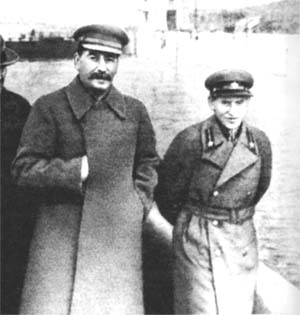
Stalin and the dwarf Yezhov
Yezhov Nikolai Ivanovich (1895-1940)
Born in Petersburg. Father — a drunken day laborer. Mother — unknown.
Illiterate. Could neither write nor read. Only at the end of his life, with difficulty, did he learn to read syllable by syllable. Alcoholic and drug addict. Late Soviet and Russian propaganda attempts to link Yezhov’s hereditary alcoholism with the idea that, while carrying out Stalin’s orders to exterminate hundreds of thousands of people, he ‘drowned his conscience in vodka.’
From age 14 he worked as an auxiliary worker at various factories.
After the February Revolution in Petrograd he joined the Communist Party. Participant in the October Revolution.
During the Civil War he served as military commissar of several Red Army units, then in party work.
From 1922 — secretary of the Semipalatinsk Provincial Committee, then of the Kazakh Regional Party Committee.
In 1927 he was transferred to Moscow and appointed Deputy People’s Commissar for Agriculture of the USSR.
Yezhov owed his rapid career advancement to the fact that, throughout all the twists and turns of intra-party struggle in the 1920s–30s, he staked everything on Stalin alone. Stalin appreciated this. On October 1, 1936 Yezhov became People’s Commissar for Internal Affairs of the USSR.
In 1934–1938 Yezhov was a member of the Central Committee of the VKP(b), chairman of the Party Control Commission attached to the Central Committee, as well as a member of the Orgburo of the Central Committee and, from 1935, a member of the Executive Committee of the Comintern.
In 1937–1938 — candidate member of the Politburo of the Central Committee, member of the All-Russian Central Executive Committee.
From 1938 — People’s Commissar for Water Transport. In 1937–1939 — deputy of the Supreme Soviet of the USSR.
In 1929–1930, as Deputy People’s Commissar for Agriculture, he took part in the unfolding of collectivization and dekulakization.
In 1933 Yezhov was appointed chairman of the Central Commission for the Purge of the Party. He was present at the execution of G. Zinoviev, L. Kamenev, and other top VKP(b) bosses. He later kept the bullets that killed them in his desk drawer as souvenirs.
On September 26, 1936 he was appointed People’s Commissar for Internal Affairs, and on January 27, 1937 he was appointed General Commissar of State Security.
He liquidated the political “Red Cross.”
In December 1937 the country pompously celebrated the twentieth anniversary of the Cheka–GPU–OGPU–NKVD. Newspapers printed full-page portraits of Yezhov. Poems were composed in his honor, songs were learned. Pioneer detachments competed for the right to bear the name of the latest executioner. Amid general rejoicing over the momentous date, a ceremonial meeting was held at the Bolshoi Theater on December 20. Sitting with Yezhov on the presidium were Molotov, Voroshilov, Kaganovich, and Khrushchev. A. Mikoyan delivered the main report. There were no superlatives high enough with which he did not crown the merits of the “wonderful, unyielding Bolshevik,” the talented “disciple of Stalin” and “the favorite of the Soviet people.” The hall greeted the speaker’s heartfelt words with unanimous applause.
In the summer of 1937 the town of Sulimov (D.E. Sulimov — chairman of the Council of People’s Commissars of the RSFSR since 1930) in the North Caucasus became Yezhovo-Cherkessk — a unique case in history — changed the name of the victim to that of its executioner.
Yezhov personally took part in interrogations and torture, and in drawing up lists of those to be shot. This could not fail to affect his personality. According to the recollections of contemporaries, by 1938 he had become a full-blown drug addict.
In 1937–1938 alone, Stalin signed 383 lists compiled on his order by the “iron commissar” for “first-category sanctions” (execution), containing 44,000 names. And on a single day, December 12, 1938, Stalin and Molotov sent 3,167 people to their deaths — significantly more than the tsarist authorities executed over the entire pre-revolutionary decade from 1905 onward.
On April 10, 1939 Nikolai Yezhov was arrested (the pretext was a denunciation by a colleague — V.P. Zhuravlev, head of the NKVD Directorate for Ivanovo Region) on charges of leading a conspiratorial organization within the troops and organs of the NKVD, engaging in espionage for foreign intelligence services, preparing terrorist acts against party and state leaders, and armed insurrection against Soviet power. In addition to these traditional charges, Yezhov was also accused of more original ones: falsifying thousands of criminal cases against his own colleagues and old party members, and homosexuality.
Lines from the confession of the accused Nikolai Yezhov:
“…In October or November 1938, during drinking bouts at my apartment, I … had an intimate relationship with the wife of one of my subordinates. And — with her husband, with whom I indeed had a pederastic relationship.”
On February 4, 1940, the day after the court sentence, Yezhov was shot in the cellars of the Lubyanka.
Shortly before Yezhov’s arrest, his second wife, Evgenia Solomonovna Gladun-Khayutina, died under mysterious circumstances at a sanatorium near Moscow.
In Soviet and later Russian literature, there is a myth that, like many other executed communists, Yezhov died with the words: “Long live Stalin!” In reality, the truth is far removed from such pompous glorifications of the Chekist executioners’ fortitude.
From the memoirs of one of those who carried out the sentence:
“And now, in a half‑asleep, or rather half‑fainting state, Yezhov wandered toward that special room where Stalin’s ‘First Category’ was carried out.
…He was told to remove everything. At first he didn’t understand. Then he turned pale. Mumbled something like, ‘But how about…’
…He hurriedly pulled off his service tunic… to do so he had to take his hands out of his trouser pockets, and his commissar riding breeches — without a belt or buttons — fell down…
When one of the investigators lunged at him to strike him, he plaintively begged, ‘Don’t!’
That’s when many recalled how he had tortured detainees in their offices, becoming especially satanic at the sight of powerful, tall men (Yezhov’s height was 151 cm).
Here the guard couldn’t restrain himself — he slammed him with his rifle butt. Yezhov collapsed…
At his cry, everyone seemed to break loose. He couldn’t stay on his feet, and when he rose, a trickle of blood ran from his mouth. And he already little resembled a living being.”
There were no publications about Yezhov’s arrest and shooting in Soviet newspapers — he ‘disappeared’ without any explanation to the people. That too was in the spirit of the times of the peasant‑worker state. Or rather a state governed by uneducated alcoholics and schizophrenics. ‘Neo‑gentry,’ as a new ‘godfather’ recently called them.
Commissar Yezhov
In the flash of lightning you became known to us,
Yezhov, keen‑eyed and intelligent commissar.
The wise word of the great Lenin
Raised for battle the hero Yezhov.
Stalin’s fiery call, so ardent and bright,
Yezhov heard with all his heart, with all his blood.
When October’s dawns began to gleam,
He stormed the palace with courage in his gaze.
When the horizon blazed with war’s dread flame,
He mounted his horse and rode to the front.
Class fought against class. The earth was ablaze,
And the motherland bled in those days.
Foes closed us in a sinister ring —
Iron and steel, fire and lead.
I recall the past. In the crimson sunsets,
Through the smoke I see Commissar Yezhov.
With flashing blade, he boldly leads
The attack, the people clad in greatcoats.
He fights, learning from the great batyrs,
Such as Sergo, Voroshilov, and Kirov.
He is gentle with soldiers, harsh with enemies,
Battle‑hardened, courageous Yezhov.
When the dawn rose over the steppes
And the Kazakh people straightened their shoulders,
When shepherds rose up against the bais,
Lenin and Stalin sent us Yezhov.
Yezhov arrived and, dispelling the mist,
Raised Kazakhstan to fight for happiness,
The people followed Yezhov into the offensive.
Golden visions came true in reality.
Yezhov drove the parasites beyond the ridges,
Retook the herds, their cattle and droves.
We parted forever with the bai’s deceit,
Spring blossomed across the steppes of Kazakhstan
More lush and lovely than our former dreams.
Here everyone loves you, Comrade Yezhov!
And the people, gathering around, echo:
— Greetings to you, Stalin’s faithful friend!
But the enemy is watchful, embittered, and fierce.
Listen: at night the villains crawl,
Crawling through ravines, the fanatics bear
Nagants and bombs, the bacilli of cholera…
But you meet them, strong and grim,
Yezhov, tested in the flame of battle.
Enemies of our life, enemies of millions,
Trotskyist bands of spies crawled to us,
Bukharinites, crafty swamp serpents,
A furious rabble of nationalists…
They rejoiced, bringing us chains,
But the beasts fell into Yezhov’s traps.
Great Stalin’s faithful friend,
Yezhov tore apart their treacherous ring.
The serpentine enemy breed was exposed
By the eyes of Yezhov — the eyes of the people.
All venomous snakes Yezhov lay in wait
And smoked the vermin out of lairs and dens.
The entire scorpion brood was crushed
By the hands of Yezhov — the hands of the people.
And the Order of Lenin, blazing with fire,
Was given to you, Stalin’s loyal commissar.
You are a sword, bared calmly and menacingly,
Fire that scorched the serpent nests,
You are a bullet for all scorpions and snakes,
You are the eye of the country, clearer than a diamond.
The gray chronicler, witness of the epoch,
Absorbing all jubilations and sighs,
The centenarian, ancient Dzhambul,
Heard in the steppe a swelling roar.
A million‑voiced, ringing word
Flies from the peoples to the batyr Yezhov:
— Thank you, Yezhov, that, rousing vigilance,
You stand guard over the country and the leader!
Dzhambul,
people’s poet of Kazakhstan.
“Commissar Yezhov.” Trans. K. Altaysky.
Pionerskaya Pravda, No. 171, 20.12.1937.
Related articles
- Nikolai Soltis — serial killer and… a parishioner of Adam Bondaruk’s church Nikolai Soltis, a parishioner of Adam Bondaruk’s church, on August 20, 2001, at a family party, stabbed his…
- “Bishop” Nikolai Kotyakov Who is “bishop” Nikolai Kotyakov! Education — primary. But he poses as a learned man!…
- Soviet History A film made in 2008 in the Baltics about the criminal, godless, Soviet power of the USSR. The extermination of Ukrainians…
- Adam — an astonishing turncoat who betrayed, persecuted, and harassed the emigration (that is, “anti-Soviet activity”) together with atheist commies in the USSR! or: The insight of the “Bethany” church initiated the difficult but extremely necessary process of overthrowing the very resourceful religious imitator and America’s chief religious mafioso! The article has been updated and edited 6 times and will be updated. Foreword to the article: After the publication of this…
- Blasphemous and murderous documents excluded from the 55 volumes of the godless ghoul in the mausoleum The question of the teraphim’s location in the ziggurat has not only occult significance, but also quite political. Maybe…
- Religious “refugees” once again “became famous” throughout the world! Investigation verdict: Nikolai Lazukin killed his wife and three daughters, Devin Matlock, set the house on fire, and shot himself The police have completed the investigation into the high-profile murder of the Lazukin family. The essence of what happened: Nikolai Lazukin, a resident of Salem —…
- Video: KGB in the Church The KGB, on orders of the CPSU, destroyed the church through its 5th Directorate. Selection and training of personnel for…
- Video: The Exodus and its enemies — our “pharaohs”: Victor Belykh, the Radchuk family, Nikolai Kotyakov, Adam Bondaruk… their number is legion The exodus from the USSR and its enemies: Presiding Bishop Victor Belykh — and he blessed his children to…
- Executions of Christian martyrs in the Kolyma camps of Dalstroy in 1937 …On October 25, 1937, 1950 people were sentenced to execution: for sectarian activity — 628…
- Vasiliy Mitrokhin Archive: The penetration and persecution by KGB of the Ukrainian Greek-Catholic Church Though never fully satisfied by the extent of its stranglehold over the Orthodox Church, the…
- The destruction of the church proceeds according to 1923 instructions from Siberia “What has been will be again, and what has been done will be done again; there is nothing…
- Ruslan Zabily: I am interested not in the names of the informants, but in how they became ones Historian Zabily again came to Kyiv for an SBU interrogation. “For me as a historian, it is interesting…