Ruslan Zabylyi: I'm Not Interested in the Names of Informants, but How They Became Them
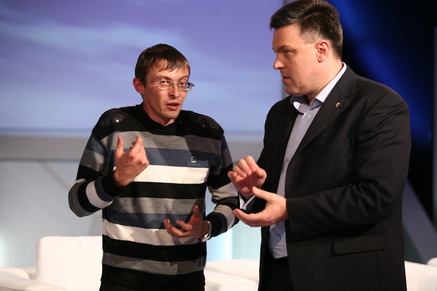
Lviv historian Ruslan Zabilyy and leader of the Ukrainian nationalist party “Svoboda” Oleh Tyahnybok
Historian Zabilyy again came to Kyiv for an SBU interrogation. “For me as a historian, it is interesting to understand the conditions and circumstances under which people ended up in agent-combat groups.”
Lviv historian Ruslan Zabilyy, a researcher of the Holodomor and the activities of the OUN-UPA, who five months ago was suddenly detained by the SBU, which seized his computer and documents, accusing him of divulging state secrets, again came to the capital for an interrogation at the SBU. Let us recall that both society and politicians unequivocally interpreted this detention as pressure on a scholar who studies the history of the liberation movement. We asked Ruslan a few questions:
-
Ruslan, after your detention five months ago, SBU Chairman Valeriy Khoroshkovskiy said that you had access to classified information, in particular, you possessed a list of sexots who worked for the KGB (against the UPA). Did you really have such access? And did you resist the temptation to make a copy of the list of “snitches”?
-
I worked exclusively with the documents that were in the SBU archive. I did not have the opportunity to work with other classified documents, particularly those you are talking about. Unfortunately, in Ukraine many documents remain inaccessible to researchers… My sphere of scientific interests is the history of the UPA, the liberation movement. I reviewed a great many materials related to the OUN and UPA, including those concerning the punitive-repressive system directed against the liberation movement. But I did not deal with the agent network. Moreover, every historian has an understanding of professional ethics. A historian who publishes information takes responsibility for its disclosure. I did not do that.
-
Surely you’re not interested in who personally “leaked” on the UPA?
-
The lists of people themselves say nothing. For me as a historian, it would be more interesting to understand the conditions and circumstances under which people fell into the clutches of the NKVD-KGB. It would be interesting to investigate what these agent-combat groups did. Frankly speaking, even before I worked at the “Prison on Lontskoho” museum, I had the opportunity to communicate with some real agents. They were elderly people who wanted to tell what happened to them and how their lives were broken. I did not make such information public… These are life stories that it is better not to talk about. They are broken fates, shattered families, and in the end, humanly speaking, I felt sorry for these people.
-
So KGB agents came to you with their historical confessions?
-
I wouldn’t say that they were, in the classical sense, an agent network. They were ordinary peasants, former underground members or those who helped the underground. Wishing to crush the underground, the NKVD bodies did not disdain any means and, accordingly, broke people. Although such village agents were of very little use to the punitive-repressive system. But people’s lives were ruined forever. The circumstances were such that not only the lives of these people but also those of their family members, young children, were under threat. And not everyone could endure. This topic is very complex and dramatic, and historians should treat it extremely carefully. And simply making the list public, without any interpretation or analysis, does not reveal the truth or the actual state of affairs.
-
Ruslan, they wouldn’t have taken you into the “Halychyna” division. You have too soft a heart…
-
I try to approach these issues from a professional point of view and not be guided by any emotions, sympathies, or antipathies. I believe that in order for us to successfully overcome the consequences of totalitarianism, we must study the past — both heroic and tragic. You know, I often ask people I respect: was it worth it for Ukraine to carry out lustration? And even the most moderate patriots believe that in that case we would have a different Ukraine. We wouldn’t be tormented by questions: what guides high-ranking officials when they make various state decisions in Russia’s interests, not Ukraine’s… Lustration did not harm the Czech Republic, Poland, Slovakia, Lithuania, Latvia. But in order to carry out this process, society must be ready for it. All documents relating to the activities of totalitarian regimes must be studied. An appropriate legislative framework is necessary… Only when we have put the historical dots on the “i” could such a process begin. Yet today our national memory has not been formed; it is, so to speak, split. In the conditions of contemporary Ukraine, completely different values are being imposed on us… Politicians abuse historical issues. And in such a situation, the question of lustration is inappropriate.
-
The SBU apparently has claims against you because you downloaded “secret documents” from the Internet — from the KGB documents online site about the activities of Soviet special services in the Baltic states… Is that true?
-
Yes, these were various Soviet NKVD documents from the 1940s that had an all-Union character. Therefore they also concerned Ukraine. These materials are not yet accessible in our agencies, but have been published by scientific institutions of the Baltic countries. As a historian, I believe I have the full right to use those materials that are freely available on the Internet.
-
And what exactly did the Balts declassify that we cannot declassify?
-
They went much further than the Ukrainian authorities… The materials concerning the punitive-repressive system in their countries have long been declassified. I was only interested in documents of a directive nature that dealt with the activities of the NKVD not only in Lithuania and Latvia, but also on the territory of Ukraine. What kind of documents did the Baltic states declassify, and we cannot? I must admit, since my computer was taken away, I haven’t seen them for a long time, so I don’t remember the details. They concern the fight against liberation movements in those states. The means and methods were the same as in Ukraine.
-
How did the SBU talk to you this time?
-
There was no pressure this time. Everything happened in a businesslike atmosphere. How did the SBU officers justify not returning your computer? Until the examination of the materials is completed, they won’t return it.
-
Did it seem to you that the SBU wants to drop the case and get out of this situation more or less decently, or does it intend to keep pressuring you as a historian?
-
It’s hard to say. I’m not ready to answer that question, because I don’t want to appear biased.
-
Are you afraid?
-
No.
Conversation by Masha Mishchenko.
SBU Detains Director of the National Museum-Memorial “Lontsky Prison” Who Worked with Secret Documents
On September 8, 2010, in Kyiv, historian and researcher of the liberation movement, director of the National Museum-Memorial to the Victims of Occupation Regimes “Lontsky Prison” (Lviv), Ruslan Zabilyi, was detained for fourteen and a half hours. As reported by the press center of the Center for Research of the Liberation Movement, the historian was detained for working with declassified documents. Today at 13:00 in Kyiv, Zabilyi and former director of the SBU Archive Vladimir Vyatrovich are holding a press conference where they plan to reveal whom the declassified documents threaten.
Recall that Vyatrovich earlier noted that the “untried” crimes of the past continue to weigh on the present, and the practices of past criminals tempt those in power with their “effectiveness.”
https://ru.tsn.ua/ukrayina/vo-lvove-sbu-zaderzhala-issledovatelya-osvoboditelnogo-dvizheniya.html
The Security Service states that the historian-researcher Roman Zabilyi is an SBU employee and was detained for intending to disclose state secrets. This is stated in a message from the SBU press service, distributed on Thursday, September 9, 2010.
“The SBU opened a criminal case on the fact of preparation to disclose information that constitutes a state secret by an SBU employee.” “It has been established that SBU employee R. V. Zabilyi, with the purpose of transferring it to third parties, unauthorizedly collected information that constitutes a state secret,” the document notes. The SBU press service also reports that upon his arrival from Lviv to Kyiv on Wednesday, he was detained with this information. “The circle of persons for whom this information was intended is now being established,” the message says.
As reported, SBU officers seized from the historian, director of the Lviv National Museum-Memorial “Lontsky Prison” Ruslan Zabilyi all materials concerning the activities of the OUN-UPA and advised him “to think about his family.”
“SBU officers allowed me to make two calls to my wife and, while demanding the materials from my computer, advised me to think about my family,” the scholar said.
R. Zabilyi also reported that SBU officers, among other things, asked him how he felt about the Holodomor, why he studied the UPA topic, and advised him to go work as a school teacher.
On September 10, 2010, at 10:00 a.m., about 200 picketers gathered at the walls of the SBU Main Directorate in Lviv Oblast. The picket was prompted by the SBU’s detention of historian Ruslan Zabilyi (director of the museum-memorial “Lontsky Prison”), who is accused of attempting to publish documents containing state secrets. This was reported by the Center for Research of the Liberation Movement.
Ruslan Zabilyi’s research focuses on the activities of the OUN-UPA; documents from this period cannot constitute a state secret. Lviv residents spoke out against the introduction in Ukraine of repressive methods reminiscent of deep Stalinism against “dissidents.” They also demand that Memorial workers be allowed back to their workplaces. The picket was organized by the joint efforts of youth and public figures. Among the participants were veterans of the OUN and UPA, many history students, including an organized group from the history faculty of the Ukrainian Catholic University.
“We will not allow censorship and secrecy in history! The persecution of Ruslan Zabilyi is a cynical attempt by the SBU to stop the dissemination of previously declassified KGB documents—it violates Ruslan Zabilyi’s right to creative activity and our rights as citizens to access information,” commented Olga Salo, an activist of the public movement “Otpov” (Resistance).
Unfortunately, none of the leaders of the regional SBU saw fit to come out and comment on the situation. The only reaction to the picket was the closing of open windows amid shouts of “Shame!” directed at the recent actions of their leadership.
At the picket, an address by historians was read out, noting that the repressions did not accidentally target a researcher who studies a topic as inconvenient for the official authorities as the Ukrainian liberation movement of the twentieth century. A number of human rights organizations, in particular the Ukrainian Helsinki Human Rights Union, have already expressed their outrage at the actions of the current authorities.
According to Ruslan Zabilyi himself, he was detained for 14 hours. It is worth noting that earlier the Center for Research of the Liberation Movement stated that historian Zabilyi was detained for working with declassified documents. Later, the Security Service stated that the detained scholar is an SBU employee and was detained for intending to disclose state secrets. Based on this fact, the special service has already opened a criminal case under Part 1 of Art. 15, Art. 328 of the Criminal Code of Ukraine.
Ruslan Zabily accessed SBU materials concerning agent networks and recruitment during the USSR KGB era
A source within the SBU reported that the reason for the detention of Ruslan Zabily, director of the Lviv Museum of Victims of Occupation Regimes “Prison on Lontskoho,” was that he had reached, in the security services’ archives, materials on the agent network and recruitment by the KGB of the Ukrainian SSR. This is reported by the newspaper “Segodnya.”
“Zabily, having access to the security service archives, got into things he shouldn’t have. Into materials very far from OUN-UPA, for example, those concerning agent networks and recruitment during the KGB of the Ukrainian SSR era. His own people informed on him, and SBU head Khoroshkovsky gave the go-ahead for detention. They checked—indeed, there were piles of classified documents. Where was he taking them, why, to whom did he want to transfer or sell them? There were no clear answers from Zabily,” said an anonymous acting SBU officer.
“They won’t put him in jail, but they’ll frighten him to deter others from trying,” he noted. According to him, the SBU archives contain materials that, in the current political situation, could turn against well-known politicians and high-ranking officials, because many of them, during the Soviet Union, openly or secretly collaborated with the KGB, and later with the SBU. “Segodnya” notes that a group of scholars from Harvard, Cambridge, and other world universities have spoken out in support of Zabily. In a collective petition to the Ukrainian authorities, the scholars ask “not to politicize history” and point out that the incident is a return of the country to totalitarianism.
Zabily reported that SBU officers, without his permission, seized his laptop and two hard drives containing the entire collection of materials related to the activities of the OUN-UPA. In turn, the SBU stated that Zabily is an SBU employee and was detained on suspicion of disclosing state secrets.
On September 14, 2010, the SBU conducted searches in the offices of employees of the National Museum “Prison on Lontskoho” in Lviv. As a result, two laptops, one hard drive, and paper copies of historical documents were seized from the scholars’ offices.
https://ru.tsn.ua/ukrayina/zaderzhannyy-lvovskiy-istorik-nakopal-materialy-verbovki-kgb.html
Khoroshkovsky confuses Ukrainian “Secret” classification with Soviet “Secret” — Ruslan Zabily
The head of the SBU is once again misleading the public, deliberately confusing Soviet “Secret” classification and Ukrainian “Secret,” and continues to assert that the SBU supposedly has grounds to regulate scholarly activity.
The director of the National Museum “Prison on Lontskoho,” historian Ruslan Zabily, stated that the head of the Security Service of Ukraine, Valery Khoroshkovsky, is confusing Soviet “Secret” classifications with Ukrainian “Secret” ones.
Recall that in an interview with the newspaper “Segodnya,” the head of the SBU said that Ruslan Zabily allegedly took “a diskette with working information” to Kyiv, thus “violating service instructions and, most likely, the law of Ukraine.” The SBU head also claimed that “documents with a ‘Secret’ classification on this diskette do exist.”
“I advise Mr. Khoroshkovsky to send those employees who are continuing the investigation into history to the information and reference room — the SBU’s open electronic archive, where every historical document (except photos) bears the classification ‘Secret,’” the press service of the Center for Research on the Liberation Movement (TsIOD) quotes Zabily.
“Khoroshkovsky, commenting on the historians’ case, is deliberately confusing Soviet ‘Secret’ classifications with Ukrainian ‘Secret’ ones,” the TsIOD press release states. “We remind the Security Service of Ukraine that in Ukraine only the classifications ‘Secret’ and ‘Top Secret’ are in force. None of the copies of historical documents illegally confiscated by the SBU from historian Zabily bear such classifications; moreover, according to Ukrainian legislation, they cannot contain them.”
Furthermore, the director of the National Museum “Prison on Lontskoho,” historian Ruslan Zabily, noted that as a scholar and head of a museum institution, he worked only with historical information that does not contain state secrets and that was necessary for writing scholarly works and preparing the museum exhibition.
Reference:
On September 8, SBU officers in Kyiv illegally detained historian Ruslan Zabily and interrogated him for 14.5 hours, and without any court sanction and with numerous violations of procedural legislation, seized his laptop and two external hard drives.
In addition to Ruslan Zabily’s own scholarly research, these information carriers contained electronic copies of historical materials and archival documents that do not constitute, and under the law cannot constitute, state secrets.
However, on September 9, official SBU information appeared about the opening of a criminal case on the fact of preparation to divulge information constituting a state secret.
Afterward, the SBU conducted an unauthorized search in the offices of historians at the “Prison on Lontskoho” museum in Lviv and seized two laptops, one hard drive, and paper copies of historical documents. Also seized were video testimonies of dissidents, recorded by researchers during 2009–2010.
The First Deputy Head of the SBU reported in a letter dated October 14 (received on October 20) that “the specified criminal case has been assigned the ‘Top Secret’ classification.” Human rights defenders comment that this fact represents an attempt to restrict the right to defense of R. Zabily and to limit public oversight of this case.
Several hundred scholars from around the world, as well as human rights and public organizations, have spoken out in defense of Zabily.
The SBU is looking for state secrets where, by law, there cannot be any
State secrets are only the information defined as such by the Law of Ukraine “On State Secrets.” And it is precisely for its disclosure that criminal liability is provided.
Information classified as state secrets is listed in a special document, “Compilation of Information Constituting State Secrets.” No historical documents are in this list.
The law prohibits the concealment of historical documents, especially those containing information about violations of human and civil rights and freedoms and unlawful actions by state authorities and their officials.
National Memorial Museum of Victims of Occupation Regimes “Prison on Lontskoho”
This is a museum created in the former dungeons of the KGB and the Gestapo — one of only two in Eastern Europe (the second one is in Vilnius, Lithuania). Initiated by the Lviv community, the museum opened on June 28, 2009; on October 14, it received national status.
By the end of this year, the museum is scheduled to open an exhibition on the persecution of dissidents. SBU officers illegally seized two laptops from museum staff containing copies of historical materials, along with video recordings of dissidents’ reminiscences made in 2009–2010, and documents provided by dissidents and obtained from foreign archives.
Similar articles
- This is relevant! How to prevent cancer development, how to prevent cancer, how to kill cancer! Nutrition for tumor diseases. Numerous evidence shows that people who eat fruits and vegetables…
- Instructive film «Forgive me, Sergei» based on Sergei Kurdakov’s book «Forgive me, Natasha» Sergei Kurdakov’s book «Forgive me, Natasha» came into my hands, almost immediately — upon arrival…
- Vladimir Vorontsov: How and by what method, for my denunciations, Lyonya (Adam) Bondaruk destroyed me and my family I present an article by Vladimir Vorontsov, a minister of an unregistered church since Soviet times and a former church minister…
- Video: Fables of Pavel Franchuk as a phenomenon in the church and their consequences We apologize that in the past, to my video explanation about the “testimonies” of Pavel Franchuk there was, due to…
- Vladimir Kastorny. On how to recognize an active agent “What nonsense are you spouting? What agents?” — this (or approximately this) may be declared by some…
- Blasphemous and murderous documents excluded from the 55 volumes of the godless ghoul in the mausoleum The question of the location of the teraphim in the ziggurat has not only occult significance but also quite political. May…
- Vasiliy Mitrokhin Archive: The penetration and persecution by KGB of the Ukrainian Greek-Catholic Church Though never fully satisfied by the extent of its stranglehold over the Orthodox Church, the…
- Adam — an amazing turncoat, who betrayed, persecuted and chased emigration (i.e. “anti-Soviet activity”) together with atheist communists in the USSR! or: The insights of the Bethany Church marked the beginning of a difficult but extremely necessary process of overthrowing a very cunning religious imitator and the main religious mafia boss of America! The article has been updated and edited 6 times and will be updated. Foreword to the article: After the publication of this…
- I will be away until Monday. I am leaving on October 18 for Washington, DC. A visit to more than twenty Congressmen is scheduled for October 19. They will be presented with a petition, as well as a gift —…
- Video: Anti-Christian manipulation of consciousness — as a means of controlling the church before the coming of the Antichrist. …
- Cancer is a thrush fungus — it is curable as a fungus — Dr. Tullio Simoncini Eight million people worldwide die from cancer every year. In the USA alone, this figure amounts to…
- Vladimir Soloveychik on Orthodox Old Believers: “Fiery” Archpriest Avvakum against Westernizers and hucksters Three hundred and sixty years ago, the great religious schism began, echoing in popular life for centuries,…