Infiltration of Soviet secret services into religious organizations in the 1960s–70s
 Fr. Sergei GOLOVANOV
“Faith and Freedom”, 29 November 2010 (Rus.)
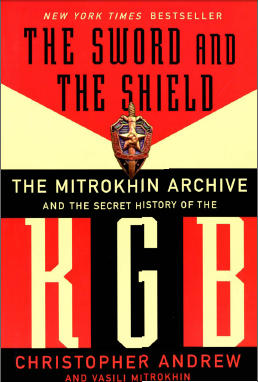
Review of the book by Christopher Andrew and Vasily Mitrokhin “The Sword and the Shield: The Mitrokhin Archive and the Secret History of the KGB”
On October 17, 1995, Christopher Andrew (b. 1941), Professor of Modern History at the University of Cambridge, was invited to a branch of British intelligence, SIS (MI6), to review secret documents smuggled out of Moscow. The documents consisted of penciled notes on notebook pages and, by their appearance, could only provoke a smile. This was the so-called “Mitrokhin Archive,” information about which had already leaked to the press. In 1993, American journalist Ronald Kessler published a book about the FBI, where he mentioned in passing that a former KGB officer who had access to secret archives had fled to the West.
Prof. C. Andrew was a well-known researcher of intelligence services’ activities: he had previously worked with KGB Colonel Oleg Gordievsky, a defector from the USSR, on the book “KGB: The Inside Story” (Andrew & Gordievsky, “KGB: The Inside Story”; there is a Russian translation). After the book’s publication in 1992, the Disinformation Department (Department MS) of Russia’s Foreign Intelligence Service (SVR) undertook measures (so-called active measures) to undermine confidence in this publication.
At the beginning of 1996, at the invitation of Prof. Andrew, V. N. Mitrokhin and his family came to Cambridge, where they visited Trinity College, where members of the famous “Cambridge Five” — secret agents working for the USSR — had studied in the 1930s.
Biography of V. N. Mitrokhin
Vasily Nikitovich Mitrokhin, in conversation with Christopher Andrew, did not reveal his exact place of origin. He only reported that he was born in 1922 in the European part of Russia and joined the state security organs in 1948 as an intelligence officer. In 1952, Mitrokhin was sent on a foreign assignment to spy on Yuri Alexandrovich Zhukov (1908–1991), the “Pravda” correspondent in Paris.
In 1956, Mitrokhin was recalled from abroad and assigned to work in the archive of the First Chief Directorate (Foreign Intelligence) of the KGB, where he handled correspondence between the central apparatus and local directorates. In 1968, Mitrokhin, along with other staff members of the internal apparatus of the FCD, was in East Germany for reinforcement in case of war with NATO over Czechoslovakia. Mitrokhin participated in a historic meeting at the Soviet military base in Karlshorst, which was conducted by KGB Chairman Yuri V. Andropov. In 1972, the FCD headquarters relocated from the main building on Lubyanka Square to a new residency in Yasenevo. Mitrokhin gained access to the most valuable documents of Soviet political intelligence: over 12 years, he checked and transported 300,000 archival files. Ordinary intelligence officers could not freely browse the secret archive: only references or files directly related to an intelligence officer’s specialization were issued. The most important files of Department S (illegals) remained on Lubyanka Square for the subsequent 10 years.
In 1972, following inner motives, Mitrokhin decided to make extracts from secret files and keep them in a hiding place. In the Lubyanka archive, Mitrokhin paid great attention to the personal files of illegals. At first, he simply memorized surnames, first names, patronymics, code names, and key facts from secret folders, and then wrote them down in a notebook at home. Later, while working on archiving agent files, he made extracts on scraps of paper, threw them in the wastebasket, and at the end of the working day put them in his pockets when leaving. Security personnel at the main KGB building only checked briefcases and folders of employees. At home, he sewed the notes into his mattress. Mitrokhin understood that preventive surveillance could periodically be conducted on him, so he avoided places frequented by foreign tourists. On Sundays, he traveled to his dacha, where he typed up the extracts on a typewriter and hid them under a floorboard in a milk can. When the next can was full, he buried it in the ground. In the summer during vacation, he went to the Penza region, where he bought a house as a dacha and worked, trying not to attract the attention of local villagers.
In 1984, Mitrokhin retired with the rank of Major and continued to systematize his notes. He constantly pondered how they could be taken to the West. In 1987, after Mathias Rust’s flight to Red Square, Mitrokhin considered enrolling in a flying club and, during a training flight, flying to Finland.
After the collapse of the USSR in March 1992, Mitrokhin traveled to Riga with a shopping trolley. First, he approached the American embassy, where they mistook him for a history enthusiast and showed no interest in his notes. Then he went to the British embassy, where he presented his passport, party card, KGB pension certificate, and showed several typewritten pages. British intelligence, from the content of the notes, immediately assessed the high value of the material and arranged for the exfiltration of Mitrokhin, his family, and the archive to the West. On November 7, 1992, Mitrokhin arrived in Latvia with his entire family and soon found himself in London.
Mitrokhin did not remove a single physical document or photocopy from the secret archive. His collection consists of handwritten extracts and typewritten compilations. Despite the unpresentable nature of such documents, they were accepted for consideration as evidence in Western courts and parliamentary commissions investigating the activities of Soviet intelligence in the West during the Cold War period.
The Book “The Sword and the Shield”
In 1996, British Foreign Secretary Malcolm Rifkind granted Prof. Andrew permission to write a historical study based on the materials of the Mitrokhin Archive. Before the book’s publication in 1999, only a small number of people from the intelligence community knew about the existence of the defector Mitrokhin and his collection.
On September 11, 1999, an announcement of the book The Sword and the Shield by Mitrokhin and Andrew appeared in The Times newspaper. After that, several journalists little known in the West suggested that Major Mitrokhin’s defection to the West had been organized by a conservative faction within the SVR, which sought to sustain tension between the West and Russia. According to Andrew, publications of that kind were a typical active measure of the SVR.
The book, which came out in late 1999, saw several editions in the United States and Great Britain, and became a bestseller according to The New York Times. It grips the reader from the very first pages, and it is unclear/clear why there is still no Russian-language version. To make the text more readable, the publishers render code names of agents and targets of operational development in CAPITAL LETTERS, exactly as was done in the primary sources themselves.
KGB Operations against Foreign Religious Organizations
The 28th chapter of the book is devoted to the penetration of the intelligence services into religious organizations and the persecution of individual believers. Mitrokhin’s archive, which is mainly devoted to foreign-policy operations using illegals, contains very scanty information on this subject, yet even this makes it possible to shed light on that part of our recent history. A secret KGB directive from 1961 reported:
About 600 people are studying in two theological academies of the Moscow Patriarchate and five theological seminaries. This circumstance should be exploited in the interests of the KGB. We must implant our people among the students of these educational institutions, so that they gradually become conduits of state influence inside the Russian Orthodox Church and subsequently over the faithful.
The head of the Second Chief Directorate (counterintelligence), General Oleg Mikhailovich Gribanov, reported in 1962 that over the previous two years the KGB had implanted “valuable agents” into leading positions in the Russian Orthodox Church, the Catholic dioceses of the Baltic region, the Armenian Apostolic Church, and other religious organizations of the USSR. Subsequently, these agents operated successfully in the interests of the Soviet Union both internationally and domestically. An important task of the CENTRE (KGB Headquarters) was to counter the adoption of anti-communist declarations at the World Council of Churches.
A KGB report from August 1969:
“Agents ALTAR, SVYATOSLAV, ADAMANT, MAGISTER, ROSHCHIN, and ZEMNOGORSKY traveled to England to take part in the work of the Central Committee of the World Council of Churches. The agents acted with a view to preventing hostile activity [public criticism of Soviet religious persecution]…
The most important of the agents at the WCC Central Committee meeting in Canterbury was ADAMANT, officially: the head of the Russian Orthodox Church delegation, Metropolitan Nikodim Rotov (1929–1978). Mitrokhin did not see the file on the WCC from 1961, but using materials from another file he identified ADAMANT as Metropolitan Nikodim. As a result of information leaks after the fall of the USSR, it became known that Metropolitan Nikodim’s close friend and successor as chairman of the Department for External Church Relations, Metropolitan Yuvenaly Poyarkov (b. 1935), inherited his KGB code name ADAMANT after Nikodim’s death – an extremely unusual practice for an agency where code names were not reused.
The KGB summary stated that at the Canterbury conference the CENTRE achieved success in “promoting agent KUZNETSOV to a leading post in the WCC.” Agent KUZNETSOV was Aleksei Sergeevich Buevsky (1920–2009), secretary of the Department for External Church Relations of the ROC and Metropolitan Nikodim’s closest associate.
Among the KGB agents used to exert influence on Western churches was Hieromonk Iosif Pustoutov (b. 1944), recruited in 1970 at the age of 26 under the code name ESAULENKO. Over the next several years, agent ESAULENKO was sent by the church authorities on missions to the Netherlands, West Germany, Italy, and France. In 1976 he was appointed representative of the Moscow Patriarchate at the headquarters of the Christian Peace Conference (CPC) in Prague. To maintain contact with him, his handler Evgeny Vasilyevich Medvedev engaged him to take part in receptions organized by the Soviet embassy.
In 1971, Metropolitan Nikodim’s personal secretary and confidant, Nikolai Lvovich Tserpitsky (b. 1946), was recruited under the code name VLADIMIR for foreign-policy operations, and Archbishop Kiprian Zernov (1911–1987), rector of the Church of All Who Sorrow (agent SIMONOV), was recruited for internal operations.
The KGB used recruited clergy of the ROC not only to keep watch over émigré communities abroad, but also to recruit agents. Inside the foreign residencies of the PGU there existed a special department “Émigrés,” whose officers tracked the activity of the Russian diaspora – usually quite innocuous (tea parties, literary evenings) – and sent reports about the work done to the CENTRE.
In the 1970s, agent PETROV, i.e., the ROC clergyman Petr Raina (1921–1994), was sent to North America. To make contact with him, his handler used the password “Petr Mikhailovich,” the given name and patronymic of his former handler in the Fifth Directorate of the KGB (dissidents and ideology) in Moscow.
Priest Arkady Rodionovich Tyshchuk (agent VORONOV) served as a clergyman of St. Nicholas Orthodox Cathedral in New York from 1977 to 1982. His agent file describes him as a “good pastor” and a “truly Russian spiritual father.”
In addition to political intelligence, Russian Orthodox clergy were used in the interests of Directorate “S” to collect documents for providing illegals with cover legends. Thus, in the early 1970s, Archpriest Ivan Grigoryevich Borcha (agent FEDOR) studied the system of civil registration in Catholic and Protestant parishes in the provinces of Alberta and Saskatchewan, Canada. His very valuable observations helped improve support for illegal agents sent to the West. Work in this area was continued by agent PATRIOT, i.e., Priest Viktor Sergeevich Petlyuchenko (b. 1940), who served as a clergyman of an Orthodox parish in Edmonton.
Clergy of the Russian Orthodox Church played prominent roles in the “Rodina” society, created through the efforts of the KGB. The vice-president of the society was R. I. Vasiliev, a senior officer of the 19th Department (Émigrés) of the PGU, who managed to create an entire secret intelligence department on the basis of the society. Extensive public activities within the “Rodina” society were carried out by agent DROZDOV, also known as Metropolitan Alexy Rediger (1929–2008).
Operations against the Vatican
In July 1967, a meeting of the heads of the intelligence services of the Warsaw Pact countries took place in Budapest to develop approaches for operational work against the Holy See. The meeting was attended by senior KGB officers Agayants and Khamazyuk, who reported on the hostile activities of the Vatican and the Catholic and Uniate clergy on the territory of the USSR. The third Soviet participant, senior officer Kulikov, spoke about certain aspects of agent activity against Vatican institutions.
All participants, with the exception of the representative of Romania, agreed that it was necessary to intensify operational activity against the Vatican in close connection with work against the Main Adversary (NATO).
In the 1960s, the Centre repeatedly mentioned the Vatican in directives as a party conducting hostile activity against the USSR. Andropov, who became KGB chairman in 1967, had an obsessional idea that the Vatican was nursing a plan to dismember the USSR, allegedly developed by Vatican Deputy Secretary of State Cardinal Giovanni Benelli (1921–1982). Therefore, on 4 April 1969 Andropov approved further “measures to intensify the struggle against the hostile activity of the Vatican and the Uniates on the territory of the USSR in 1969–70.” The directive was aimed at the First Chief (intelligence) and Fifth (dissidents and ideology) Directorates of the KGB and at local state security bodies. The PGU was tasked with intensifying agent penetration into the top echelons of the Vatican bureaucracy: the Jesuit Order, the “Russicum” and other papal colleges where priests for the churches of the Eastern Bloc countries were trained.
To this end, it was planned to begin the development of three Catholic clerics of Russian origin in Rome (objects APOSTOL, RASS, and SLUGA). According to Mitrokhin’s documents, these objects cannot be identified, but from open sources it is known that at that time several Byzantine-rite clergymen born on the territory of the Russian Empire were living in Rome: Bishop Andrei Katkov, the Jesuit Kovalenko and others.
Here is an article on the “Russicum” from the secret KGB dictionary of 1972, which found its way onto the Internet. Its authenticity is beyond doubt because it coincides in many respects with the “Soviet Intelligence Officer’s Handbook” edited by Mitrokhin (Vasili Mitrokhin “KGB Lexicon: The Soviet Intelligence Officer’s Handbook. Routledge”; 1 edition. 2002).
«Russicum» – a special Vatican college for the training of Catholic missionaries called to put into effect the policy of the so-called crusade against communism. The college was founded by Pope Pius XI in August 1929. «Russicum» is under the jurisdiction of the Congregation for the Oriental Church, but is directly run by the Jesuit Order. «Russicum» trains personnel for missionary work in Europe, Asia, Africa and Latin America. In the contemporary period, the scope of «Russicum»’s activities has expanded considerably. It is engaged in training missionary cadres to be infiltrated into the USSR and other socialist countries.
Students of «Russicum» receive religious, political, linguistic and special training. The course of study lasts 8 years. In addition to theology and other religious subjects, the students study the Russian language (down to local dialects), the history of the USSR and the history of the CPSU, political economy, and the customs of the population of our country. At the same time, the students are taught civilian professions which are used as cover. The environment in which the training of missionaries designated for infiltration into the USSR takes place is brought as close as possible to that in which they will operate in the Soviet Union. The strictest secrecy is observed. Missionaries who graduate from «Russicum» and are sent to the USSR receive the assignment to organize Catholic groups in our country and to collect information about the situation in the USSR. The Vatican sends some graduates to states bordering the Soviet Union for the purpose of establishing there support missionary points for conducting hostile work against our country.
Counterintelligence Dictionary. Moscow: Higher Red Banner School of the KGB, 1972.
Source: https://tipolog.atspace.com/count_dic/counterintell_dictionary_1.htm
This information was completely outdated by 1972. Since the mid-1950s the “Russicum” had been a clerical residence where doctoral students of the Pontifical Oriental Institute lived, and no classes at all were held there.
Nevertheless, agent penetration into the papal colleges in Rome continued, using candidates from the Eastern Bloc countries and the republics of the USSR. Agents of the Fifth Directorate PETROV, Petras Raina (1921–1994), and ROGULIN, Vladimir Rozhkov (1934–1997), arrived in Rome in January 1968 to begin three years of study at the Pontifical Oriental Institute. In 1969, they made a successful intelligence-gathering trip to the “Catholic centers” of France and Belgium. During 1969, two KGB agents from Lithuania, ANTANAS and VIDMANTAS, studied at the Gregorian University. Two other Lithuanian envoys, agent DAKTARAS (who held the rank of Catholic bishop) and ZHIBUTE, took part in a meeting of the working commission on the reform of the Code of Canon Law, which was held in the Vatican from 21 May to 11 June 1969. Agent DAKTARAS reported to his handler that at the papal audience on 7 July, Paul VI said to him: “I remember you in my prayers and hope that God will help the clergy and believers [in Lithuania].”
With the help of Hungarian intelligence AVH, the KGB succeeded in developing the Hungarian Greek Catholic bishop Dudash, a member of the Congregation for the Oriental Churches. The female agent POTOCHINA, infiltrated into the catacomb church, regularly traveled to Hungary and, having gained Dudash’s trust, asked him to pass to the Vatican information about the state of the Greek Catholic underground in Ukraine; this was disinformation created at the CENTRE.
Actions against the Vatican included a number of active measures aimed at driving a wedge between the Uniate underground, representatives of the Ukrainian Greek Catholic Church in Rome, and the Vatican congregations. Moreover, the Holy See was viewed as an effective channel for disinformation in the interest of the USSR, which was to reach the West. Key KGB agents in the Russian Orthodox Church who contacted Vatican diplomats — DROZDOV (Rediger), ADAMANT (Rotov), SVYATOSLAV (not identified), and NESTEROV (not identified) — were instructed how to mislead officials of papal institutions such as the Congregation for the Oriental Churches, the Secretariat for Christian Unity, and the “Justice and Peace” Commission. Agent ADAMANT received and successfully carried out the task of introducing disinformation into the Roman Curia to the effect that the Soviet government was planning to establish an autonomous (i.e., schismatic from Rome) Catholic Church in the Baltic region. Agent DAKTARAS, a Lithuanian Catholic bishop, transmitted the same fabricated information during the Synod of Bishops in October 1969. However, there is no evidence that this disinformation in any way influenced the policy of the Holy See or sowed confusion in the ranks of Western bloc leaders. When reading the triumphant intelligence reports copied by Mitrokhin, Professor Andrew gained the impression that they contain many exaggerations and banal Soviet embellishments: agents often passed off ordinary excursions and sightseeing trips as reconnaissance raids, and routine conversations at diplomatic receptions as massive injections of disinformation that stunned the adversary.
Operations against religious dissidents in the USSR
Actions against religious dissidents were directed by the Fifth Directorate of the KGB. By a decision of the KGB Collegium in the early 1970s, penetration of religious organizations in the USSR was intensified.
The target of development (=persecution) became the dissident Christian Committee for the Defense of Believers’ Rights, consisting of only four people (Yakunin, Kapitanchuk, Gainov, Khaibullin). As the initial target of influence, the hierodeacon Varsonofy Khaibullin (b. 1937), who served in a Moscow parish, was selected. With the help of agent GALKINA (an unidentified agent within the Russian Orthodox Church), Khaibullin was arranged a transfer to a church in Vladimir, whose rector was the experienced, long‑term agent VOLZHSKY. Having lost contact with Yakunin and Kapitanchuk, Father Varsonofy physically withdrew from participation in the Christian Committee. According to Varsonofy’s file, agent VOLZHSKY introduced him to the psychiatrist agent BULKIN, who convinced him of a predisposition to mental illness. After conversations with the doctor‑agent, Khaibullin came to the conclusion that involvement in the dissident movement could harm his health. Subsequently, the CENTRE, through its agents, directed him onto the path of scholarly work and opened materials on the history of Orthodoxy for him in the regional archive. During this scholarly work, a nearby archive employee, agent SPIRANSKY, inspired Khaibullin to renounce the role of defender of believers’ rights in the Soviet Union. In the end, Hierodeacon Varsonofy sent a letter of repentance for his dissident activity to the church leadership. This operation was regarded by the CENTRE as quite successful.
In May 1979, the priest Vasily Fonchenkov (1932–2006), recruited in 1970 under the code name DRUG, joined the Christian Committee for the Defense of Believers’ Rights, replacing the departed Khaibullin. During the campaign of persecution of dissidents in 1979–80, a cover operation was organized for DRUG: he was summoned for interrogation at the KGB, and rumors were spread that he was threatened with arrest. In 1980, at the trial of priest Gleb Yakunin (b. 1934), only his wife was present. To cover Fonchenkov, he was demonstratively barred from the proceedings. Several KGB agents gave testimony against Yakunin, including ESAULENKO (Iosif Pustoutov); as a result, Father Gleb received a five‑year prison term.
The next target of development was priest Dmitry Dudko (1922–2004), whose sermons were published abroad. On January 15, 1980, Father Dmitry was arrested on charges of anti‑Soviet activity. After numerous interrogations, investigator Vladimir Sergeyevich Sorokin induced him to cooperate with the investigation. During the Moscow Olympics, Father Dmitry made a “repentant” television appearance, after which other dissidents turned away from him. Investigator Sorokin was awarded a decoration for the development of Dudko.
Operations against the Ukrainian Greek Catholic Church.
On September 28, 1978, the CENTRE issued secret order No. 00122, “On Measures to Intensify Agent‑Operational Work in Combating the Increased Activity of Foreign Clerical Centers and Hostile Elements among Churchmen and Sectarians.” Among the objects of long‑term development was the so‑called Uniate underground, i.e., the Ukrainian Greek Catholic Church prohibited on the territory of the USSR, and its structures abroad.
Development of the Uniate underground was carried on for decades. In 1963, after Metropolitan Josyf Slipyj (1892–1984) was sent into exile in the West, his successor became Bishop Vasyl Velychkovsky (1903–1973). In order to discredit the head of the Uniate underground, the KGB planted several agents in his entourage: TIKHON, SIDORENKO, ROMANENKO, SOVA, and PODOLENIN (according to the Mitrokhin Archive, these agents cannot be identified). Agent TIKHON, a member of the underground church, periodically sent reports to Metropolitan Slipyj in Rome containing disinformation fabricated in the CENTER. According to KGB reports, Slipyj dispatched emissaries to Ukraine who confirmed the disinformation previously fed by TIKHON. In the opinion of Prof. Andrew, KGB officers traditionally overestimated their own successes, because there is no evidence of any disagreement between Slipyj and Velychkovsky.
Parallel with external measures, Andropov ordered increased pressure on the underground. In 1969, the head of the catacomb UGCC, Bishop Vasyl Velychkovsky, was arrested and sentenced to three years’ imprisonment. In the opinion of the KGB organs, this harsh measure had an overwhelming effect on another leader of the Uniate underground, who was recruited under the codename SERAFIM. He orally provided important information about the composition of the Uniate underground, but refused to sign a confirmation of cooperation. His handler did not insist, fearing a nervous breakdown in SERAFIM, and limited himself to recording the testimony on magnetic tape. In another instance, during a contact one of the agents repented and asked his handler on his knees to return his signed pledge of cooperation.
In 1971, the KGB recruited one of the leaders of the underground Greek Catholic Basilian monastery (Order of St. Basil the Great) under the codename IRINEI. IRINEI’s task in the Uniate underground was to maintain contacts with the Catholic Church in Poland. In order to induce IRINEI to cooperate, a complex and costly surveillance operation was launched on his own sister, object MARIA. Through MARIA ran a link to the UGCC underground. Long-term surveillance led to the uncovering of the addresses of a significant number of active Greek Catholics. Unfortunately, at the height of the operation MARIA died suddenly, after which IRINEI fell into a deep depression. Most likely Maria died a natural death, i.e., without assistance from KGB personnel. The operation’s handler decided to exploit the sister’s death in order to “break” IRINEI: he was told that MARIA had been a KGB agent and for many years had been reporting information on the life of the Uniate underground. The data obtained through surveillance were interpreted as MARIA’s agent reports. IRINEI experienced a profound shock, after which he disclosed everything, because he was convinced that his sister had already betrayed everyone. At the same time, IRINEI refused to sign a pledge of cooperation.
In 1972, Bishop Vasyl Velychkovsky was expelled by the Soviet authorities to the West, where Metropolitan Josyf Slipyj had already been sent earlier. In 1973, the KGB began seeking approaches to Slipyj in order to track his contacts. At the invitation of Cardinal Pericle Felici (1911–1982), a Greek Catholic prelate from Czechoslovakia came to the Vatican—a man previously recruited by Czechoslovak intelligence and transferred to the KGB’s care under the codename PROFESSOR. Earlier, in 1971, agent PROFESSOR had been used by the KGB to uncover the underground structure of the Redemptorist order in Ukraine and the underground’s links with brethren abroad. In 1973, agent PROFESSOR met Metropolitan Slipyj in Rome. According to the KGB’s plans, the agent was to offer his services as a secret emissary of the head of the UGCC in Ukraine, but the Mitrokhin documents do not make it possible to establish whether this operation developed further.
As a priority target within the USSR, Velychkovsky’s successor, Archbishop Volodymyr Sterniuk (1907–1997), was chosen. Agent NATASHA, who had been planted in the Uniate underground, sent disinformation to Rome, via various agent channels, about the immoral conduct of the elderly hierarch. As a result, according to a KGB report, he was seriously discredited and “lost the support of a significant number of Uniates.” In Andrew’s view, this is a more than optimistic report: subsequent events showed that, on the whole, the KGB lost the war with the Uniate underground. In 1987, Sterniuk announced his emergence from the catacombs and acquired the laurels of a national hero of Western Ukrainians. In 1989, the entire UGCC was officially recognized by the Soviet authorities, despite the resistance of the KGB and the ROC.
The dissolution of the USSR in 1991 marked the crushing failure of an organization that had been called upon to ensure its security. Some of the reasons can be traced through the Mitrokhin archive: mythologizing in directives, disinformation in reports on work done, demonization of the adversary, exaggeration of one’s own successes—as a result of which the struggle of the state security organs against religious dissidents became a chain of small victories on the road to a major defeat.
Source
Book title: The Sword and the Shield: The Mitrokhin Archive and the Secret History of the KGB
Author: Christopher Andrew, Vasili Mitrokhin
Release: 1999
Publisher: Basic Books
ISBN: 0–465–00312–5
Format: Paperback, 736 pp.
Language: English
Online: available.
Abstract prepared by Sergei Golovanov specially for the portal “Faith and Freedom”
Similar articles
- Yandex covers up provocations by special services: ‘Project Sinitsky’ strides boldly across the internet! The well-known Services of Russia and, Ukraine(!) responded surprisingly promptly but, to an indecent degree openly, to…
- From the reports of the 4th Department of the 5th Directorate of the USSR KGB: Fighters of the invisible front — priests of registered churches serving the interests of the godless authorities. A vivid example is Patriarch V.M. Gundyaev. Their codename was: “Legion” Vladimir Mikhailovich Gundyaev was born on November 20, 1946, in Leningrad into the family of a priest and…
- Instructions for organizing and conducting internal (agent) surveillance by the Tsarist secret police The Tsarist authorities persecuted Protestant sectarians in part. The Soviet authorities set themselves the goal of destroying faith in God,…
- Pages from the history of our exodus from the USSR Unfortunately, “life cannot be turned back,” as the song goes. Time passes, and people are leaving,…
- Video: Avramenko’s slander, persecutions of the 1960s, and the purpose of leading God’s people out My testimony about the slanderous book against Pentecostals and the Holy Spirit by Grigory Avramenko-Agntsev, the persecutions of the 1960s,…
- Religious “refugees” have once again “made a name for themselves” worldwide! Investigation verdict: Nikolai Lazukin killed his wife and three daughters, Davina Matlock, set the house on fire, and shot himself Police have concluded the investigation into the high-profile murder of the Lazukin family. The essence of what happened: Nikolai Lazukin, a resident of Salem —…
- Religious leaders of the Russian Federation commented on the conclusions of the U.S. State Department report on religious freedom and came to the conclusion: They burn churches, but little by little, so it’s not so scary. They shell, but not systematically. They smash, but not on a mass scale. In general — it’s not all that bad! Religious leaders of Russia commented on the conclusions of the U.S. Department of State report concerning religious freedom in Russia. Russia in…
- Patriarchs in epaulettes, or KGB = FSB+SBU = ROC+UOC (MP) One often hears that Stalin’s permissive policy toward the Church was his realization…
- V. Franchuk. OCUPE and other Pentecostals in the 1990s The United Church of Christians of Evangelical Faith Until the end of the 1980s, the fellowship of unregistered churches of Evangelical Christians, despite its illegal…
- The Tallinn wind (awakening) and the midwifery of the USSR KGB A study of the Tallinn wind or awakening. Today it is acknowledged by the leaders of this “wind” that its midwives were the KGB…
- In Russia, all religious groups may be eliminated THE GUILD OF EXPERTS ON RELIGION AND LAW NON-COMMERCIAL…
- Interview with Lieutenant Colonel K.G. Preobrazhensky, former assistant to the head of the scientific and technical intelligence of the SVR KGB of the USSR Exclusive interview for the “Russian West” portal with Lieutenant Colonel K.G. Preobrazhensky, former assistant to the head of the scientific and technical intelligence of the SVR KGB…