Russia is ruled by 'Collective Politburo' No. 2
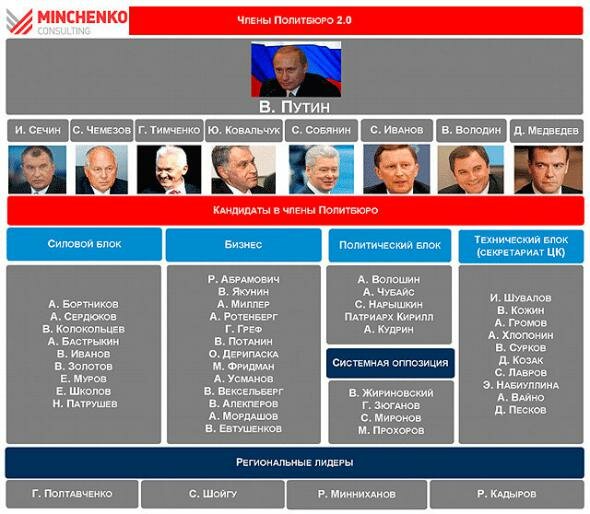 Russia is governed by a “collective Politburo”, in which President Vladimir Putin is an influential arbiter.
This is stated in a report by the Minchenko Consulting holding, which will be presented today in Moscow. According to the head of the holding and the International Institute of Political Expertise, Evgeny Minchenko, the power vertical is a political technology cliché. The new Russian Politburo was formed in the 2000s following the redistribution of resources, the destruction of media empires, and the elimination of most regional regimes.
According to some experts, virtually all of Putin’s closest associates were previously linked to the KGB of the USSR. Many of the “Politburo” were born or lived in Soviet Leningrad.
Report
The Big Government of Vladimir Putin and “Politburo 2.0”
The communications holding Minchenko Consulting presents the report “The Big Government of Vladimir Putin and Politburo 2.0,” based on the results of an expert survey of over 60 experts (representatives of the country’s political and business elite). Due to the sensitive nature of the topic, the survey was conducted under conditions of anonymity. The aim of the survey was to create a consistent model of the informal decision-making system that emerged after the electoral cycle of 2011-2012 and the personnel decisions regarding the new composition of the Russian Government and Presidential Administration. The report is of interest to regional elites, Russian business, and foreign investors.
The formation of a new structure of executive power (including the government, the presidential administration, and rotations in the governor corps) demonstrated to us a new personnel style of Vladimir Putin. The traditional scheme of creating a system of elite “checks and balances” was complicated:
- Within the Presidential Administration, a reserve “control panel” has been created vis-à-vis the government in the form of presidential aides and the specialized directorates they control. It is worth noting that, in terms of staffing, these directorates can compete with ministries and government departments in the speed of bureaucratic procedures. At the same time, there are alternative centers for personnel formation to the Presidential Administration [hereinafter – AP]. For example, the team of Vladislav Surkov, which has moved to the government, is currently sidelined from managing internal policy but is ready, if necessary, to return to carrying out this function;
- The President has formed a number of new commissions (including on the fuel and energy complex and on monitoring the fulfillment of his own election promises), which include both ministers and representatives of the AP. This demonstrates the President’s control over both the government and the administration. In effect, V. Putin’s long-standing dream has been realized—to introduce in Russia an American model in which the president leads the entire vertical of executive power (a kind of “big government”);
- While preserving existing influence groups, V. Putin is experimenting with introducing new players onto the field, who would act either as apolitical technocrat-executives personally tied to him (for example, Interior Minister V. Kolokoltsev and Economic Development Minister A. Belousov), or as bearers of alternative political platforms (the dichotomy “People’s Front” — “United Russia,” the quasi-opposition projects of Alexei Kudrin and Mikhail Prokhorov, and the “thematic” pro-government projects of D. Rogozin, I. Kholmanskikh, and V. Yakemenko);
- In the spheres of influence of major elite clans, the autonomy of individual players is ensured with the president’s support (for example, Sergei Kiriyenko in the sphere of influence of the Rossiya Bank group, and Oleg Sienko, General Director of Uralvagonzavod, within Sergei Chemezov’s group);
- The process of fragmentation of elite groups and the emergence of new players from them has continued (for example, the growing independence of Sergei Shoigu, historically linked to the “family group,” is noticeable, as well as the distancing of a number of security officials from I. Sechin);
- Putin is dismantling the “Medvedev coalition” of the 2006-2007 model, showing his favor to its members among high-ranking officials by giving them new assignments (in particular, I. Shuvalov and V. Surkov).
At present, the ruling elite1), in addition to solving its own managerial tasks, is oriented toward ensuring its stability over a long time horizon. For this, it needs:
- Conversion of power into property (through a new stage of privatization, the use of budget funds and preferences from government structures for the development of profitable businesses, and the creation of new “rents”);
- Ensuring the inheritance of property acquired in the 1990s-2000s;
- Legitimization of the acquired property, both in Russia and abroad.
The second task of the ruling elite is to strengthen its coalition, weed out undesirable members, and selectively attract new ones. The system must periodically create incentives for the redistribution of benefits in favor of successful and distinguished coalition members. It appears that the basis for the property redistribution mechanism will be three major projects:
- A new privatization;
- Greater Moscow;
- Development of Siberia and the Far East (in various organizational forms).
Literally in the first months of V. Putin’s new presidency, the technology for implementing these projects and even their very fate became the subject of fierce battles among groups within the head of state’s entourage.
Within Putin’s “big government” there is a whole series of structural contradictions, among which the following can be highlighted:
- The excessive scope of authority of such deputy prime ministers as A. Dvorkovich, I. Shuvalov, and V. Surkov, which in the future may be redistributed in favor of other or newly appointed deputy prime ministers;
- Competition for control over the financial bloc between A. Serdyukov, I. Shuvalov, and the former Kudrin team;
- Bureaucratic competition for control over the fuel and energy complex (FEC) between the secretary of the relevant presidential commission I. Sechin and the responsible deputy prime minister A. Dvorkovich (and the coalition of nomenklatura and business groups that joined him);
- Struggle for influence between the Ministry of Communications and Mass Media and the new department within the Presidential Administration headed by former minister I. Shchegolev, aggravated by the fact that the ministry has ceded a number of important powers to a newly created specialized agency.
The mechanism for resolving these and other bureaucratic contradictions is an informal body – Putin’s “Politburo 2.0.”
“Politburo 2.0”
Russia’s ruling elite can be described using the model of the Soviet collective power body – the Politburo of the CPSU Central Committee. Such a collective power system is quasi-institutional from the standpoint of nation-states, but effective in terms of the logic of “the natural state”2). The process of ruling is aimed, first and foremost, at maintaining the existing inter-clan balance.
 The Russian government is by no means a rigid vertical structure run by one person. The “power vertical” is nothing more than a propaganda cliché. Russian power is a conglomerate of clans and groups that compete with each other for resources. And Vladimir Putin’s role in this system remains unchanged – that of an arbiter and moderator, but an influential arbiter whose word in conflict situations, at least for now, remains decisive. The president’s key resources, besides his office, are personal trust-based relationships with the main elite players inside and outside the country, and the sustained trust rating among the population. Putin’s sphere of direct control includes long-term gas contracts, management of the gas industry, and Gazprom itself, as well as control over the systemically important banks (VEB, VTB, Sberbank).
In the 2000s, under the influence of a number of factors (among them: redistribution of resources from oligarchic, mostly small clans (the exception being the Yukos empire) to the siloviki; the dismantling of media empires controlled by oligarchs; the elimination of most regional regimes that had been operating in a logic of feudal free-for-all), a style of political decision-making emerged that increasingly resembles the model of the Soviet Politburo. The shift to this model was facilitated by the emphasis on creating state corporations — “national champions” — in both politics and the economy.
The specificity of the “Politburo 2.0” lies in the fact that, first, it almost never meets in general sessions. Second, the formal status of its members does not always correlate with their actual influence on the decision-making process. And third, several elite circles have formed around the “Politburo 2.0,” which can be conventionally designated as the “security,” “political,” “technical,” and “entrepreneurial” circles. These circles, on the one hand, serve as the support base for the “Politburo 2.0” in the process of ruling, and on the other hand, they themselves compete with each other for influence on the “Politburo 2.0,” including by “nominating” their own candidates for membership. Together with the administrative clans preserved from the 1990s, they form an analogue of the CPSU Central Committee of the 21st century.
As full-fledged members of the “Politburo 2.0,” we have designated the leaders of large elite groups that have their own positions both in business and in state structures (both federal and regional) and act as permanent players on the political and economic stage. An indirect factor indicating membership in the narrow circle of individuals directly influencing key decisions is active participation in the series of gubernatorial appointments that took place in the first five months of 2012. Among these figures are:
-
Ex-President Dmitry Medvedev, who lost most of the “coalition of support for a second term,” but in return gained the opportunity to create his own group with an independent economic base and such a not insignificant tool as the United Russia party. Naturally, for a time he had to give up his independent political ambitions and lost a number of his appointees in the security structures (with the departure of A. Reimer, the “Medvedevites” lost control over the Federal Penitentiary Service; and the prime minister’s fellow student V. Kozhokar — deputy minister of internal affairs and head of the Ministry of Internal Affairs’ Investigative Department — also left his post). However, by virtue of his bureaucratic position, D. Medvedev will inevitably serve as a center of gravity for competing business groups. Currently, the prime minister has a number of allies who have placed their bets on him. These include Prosecutor General Y. Chaika, and deputy prime ministers V. Surkov and I. Shuvalov. On a whole range of issues, Medvedev’s group aligns with the “family” group and the liberals surrounding it, and also tacitly relies on the support of the Kovalchuk group;
-
Sergei Ivanov, who retained the position of Vladimir Putin’s trusted figure, tasked with ensuring intra-elite balance within the Presidential Administration;
-
CEO of Rosneft Igor Sechin, who possesses extensive but informal influence. His ambition to become a key player in the fuel and energy sector meets powerful opposition not only from private companies but also from other “Politburo members” — Gennady Timchenko and Yuri Kovalchuk. Yet Sechin’s main concern is preserving his informal influence over security structures, which will inevitably weaken after he leaves government service. This means that figures historically perceived as his allies, such as A. Bortnikov, A. Bastrykin and V. Ivanov, will in reality distance themselves further from the former deputy prime minister. However, such a drift fits squarely into Vladimir Putin’s logic, aimed at splitting and fragmenting existing nomenklatura groups. At the same time, I. Sechin has acquired a new resource — a reputation as a tough and effective manager not only at home but also in relations with the West (two deals in the fuel and energy sector with an American and a French company, carried out this year);
-
The tandem of Gennady Timchenko and Yuri Kovalchuk serves as an alternative pole of influence in the fuel and energy sector to I. Sechin. The Bank Rossiya group now brings together not only the founders of the Ozero cooperative, although the contours of that long-standing partnership are still visible beneath the new financial and economic structures. As the diagram shows, the group’s resources are highly diversified. However, after the reshuffle, the group has arguably lost rather than gained: the number of people in power affiliated with it has shrunk. Yet one should not assume that G. Timchenko’s non-participation in the contest for the latest gubernatorial appointments signals a serious weakening. This fact is easily explained by the concentration of his business in a few regions where he has already settled all matters with loyal governors. Medvedev’s innovation projects, however, are directly hitting the funding and prestige of the Russian Academy of Sciences. The basis of the group’s power remains the banking and insurance business, through which major industrial assets (Atomstroyexport, the OMZ group, etc.) are controlled. The asset structure also indicates that V. Putin trusts the Kovalchuks to balance Gazprom’s interests in a number of systemically important projects. Oil trader and gas producer G. Timchenko is seeking to weaken Gazprom’s monopoly to the extent that Vladimir Putin’s political line permits. Yet the group’s relationship with Rosatom head S. Kiriyenko is turning from alliance into rivalry. Y. Kovalchuk’s influence is bolstered by a media asset, the importance of which is set to grow in the near future;
-
Sergey Chemezov’s group is today the dominant player in the defense industry. However, its influence is limited by the failures of the group’s political projects in the regions and the absence of high-profile defense projects, which is compounded by a multitude of scandals over the defense procurement order. Nevertheless, S. Chemezov’s group has recently launched a new political project, successful not so much in terms of swaying public opinion as in attracting the sympathy of the head of state (“Workers of Uralvagonzavod for Putin”);
-
Sergey Sobyanin is today not only the mayor of Moscow but also the leader of a nomenklatura group that includes several governors concentrated in the Urals. He has managed to build non-conflictual relations with most of the oligarchic structures that have interests in Moscow. Moreover, despite his genuinely tough managerial style, S. Sobyanin succeeds in winning the sympathies of the liberal beau monde (rumors are actively spread about his hidden opposition to the authorities’ harsh actions against protesting citizens). At the moment, a potentially dangerous flashpoint for Sobyanin is the conflicts surrounding the “Greater Moscow” project;
-
Vyacheslav Volodin is a newcomer to the Politburo, yet he is rapidly gaining influence, having monopolized the function of political management. Full control over the “People’s Front” project and shared control over “United Russia,” operational management of regional policy, and serious influence in parliament give Volodin powerful levers of influence. The group’s points of vulnerability are the lack of a serious economic base and the label of an “outsider” in the St. Petersburg team.
Members of “Politburo No. 2”

Vladimir Vladimirovich Putin — three-time president of the Russian Federation, “arbiter of Politburo No. 2”

Dmitry Anatolyevich Medvedev (14 September 1965, Leningrad) — ex-president of the Russian Federation, Prime Minister of the Russian Federation

Sergey Borisovich Ivanov (31 January 1953, Leningrad) — Chief of Staff of the Presidential Administration of the Russian Federation, ex-Deputy Prime Minister of the Russian Federation, ex-Secretary of the Security Council of the Russian Federation

Igor Ivanovich Sechin (born 7 September 1960, Leningrad) — Deputy Prime Minister of the Russian Federation, President of Rosneft

Gennady Nikolayevich Timchenko (9 November 1952, Leninakan, Armenia) — owner of Gunvor and Volga Resources
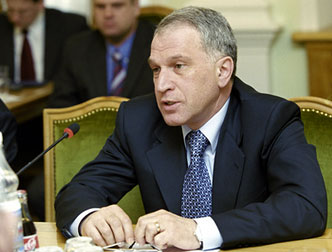
Yury Valentinovich Kovalchuk (July 25, 1951, Leningrad) — Chairman of the Board of Directors of Bank Rossiya.

Sergei Viktorovich Chemezov (August 20, 1952, Cheremkhovo) — CEO of the State Corporation “Rostec”, previously — CEO of “Rosoboronexport”, President of the Russian Engineering Union, Colonel General

Sergei Semyonovich Sobyanin (June 21, 1958, the village of Nyaksimvol, Berezovsky District, Khanty-Mansi Autonomous Okrug, Tyumen Oblast) — Mayor of Moscow, ex-Chief of Staff of the Presidential Administration of the Russian Federation, ex-Deputy Prime Minister of the Russian Federation

Vyacheslav Viktorovich Volodin (February 4, 1964, Alekseevka, Khvalynsky District, Saratov Oblast) — First Deputy Chief of Staff of the Presidential Administration of the Russian Federation.

Sergei Evgenievich Naryshkin (October 27, 1954, Leningrad) — Chairman of the State Duma of the Russian Federation, ex-Chief of Staff of the Presidential Administration of the Russian Federation.

Igor Ivanovich Shuvalov (January 4, 1967, Bilibino, Chukotka) — First Deputy Prime Minister of the Russian Federation, ex-Chairman of the Board of Directors of Sovcomflot.
***
Candidates for membership in “Politburo 2.0”. Unlike the “full-fledged” members of the informal collective governing body, who are leaders of a conglomerate comprising nomenklatura, economic, and political components, candidates for membership in the Politburo are distributed across blocs. As can be seen, such influential figures as Sergei Naryshkin and Igor Shuvalov have received only candidate status, because V. Putin needs them not as leaders of nomenklatura groups whose interests must be coordinated, but as autonomous figures performing the function of restraining the growth of influence of such groups and balancing their interests. We have also not singled out a separate “Gazprom” group, because this corporation, on the one hand, is under the direct control of V. Putin, and on the other, is divided into several competing influence groups, with Alexei Miller and to a lesser extent Viktor Zubkov acting as “overseers” of their behavior.
Also, the following should be highlighted as influential candidates for membership in “Politburo 2.0”:
-
Alexei Kudrin, who has retained significant ideological influence over the financial bloc of the Government and personal contact with V. Putin;
-
Arkady Rotenberg, who is part of the president’s business circle;
-
Nikolai Patrushev, whose group, concentrated in the Security Council, constitutes a reserve force bloc;
-
Vladislav Surkov, heading the reserve ideological bloc;
-
Alexander Voloshin, responsible for the political management of the “family group” and having significant influence over mid-level officials;
-
Roman Abramovich, who has moved from the category of “Politburo 2.0” members to candidates, as he has recently been trying to shift the center of his activities from Russia to the West.
The technical bloc (“Secretariat of the Central Committee”) of candidates includes figures personally tied to V. Putin and performing specialized expert functions. In the economic sphere, these are I. Shuvalov and E. Nabiullina, in international relations, undeniably, S. Lavrov, in the media sector, A. Gromov and D. Peskov, in regional development — A. Khloponin, V. Surkov, and D. Kozak.
Candidates for membership in «Politburo No.2

Alexei Leonidovich Kudrin (October 12, 1960, Dobele) — ex-Minister of Finance of the Russian Federation, founder of the “Committee of Civil Initiatives”

Arkady Romanovich Rotenberg (December 15, 1951, Leningrad) — Russian billionaire, judo coach, owner of “Stroygazmontazh”, “Severny Morskoy Put” bank, the “Northern European Pipeline Project”, numerous distilleries, hotels, and gambling houses.

Vladislav Yuryevich Surkov (September 21, 1964) — Deputy Prime Minister of the Russian Federation, author of the concept of “sovereign democracy”

Alexander Stalyevich Voloshin (March 3, 1956, Moscow) — ex-Chief of the Presidential Administration of the Russian Federation, Chairman of the Board of Directors of “Russian Nickel”

Roman Arkadyevich Abramovich (October 24, 1966, Saratov) — billionaire, ex-Governor of Chukotka, Chairman of the Duma of Chukotka.
***
The political bloc of candidates includes figures who influence the ideological design of the authorities’ actions, offering their own versions and scenarios of development. Therefore, it includes not only the ideologues of the liberal course (A. Kudrin, A. Chubais, A. Voloshin) but also Patriarch Kirill, who claims a role in shaping state ideology. At the same time, we deemed it possible to include representatives of the systemic opposition in the circle of candidates for membership in the Politburo, since none of them is engaged in a real struggle for power. All of them are integrated into the system and bargain with it with varying degrees of success. So far, the greatest dividends in the form of personnel appointments for people close to him have been received by M. Prokhorov (O. Golodets for the post of Deputy Prime Minister and S. Eroshenko for the post of Governor of the Irkutsk Region). Although it is worth noting that in both cases, M. Prokhorov, in lobbying for these appointments, acted in alliance with other elite groups: in the case of O. Golodets, together with S. Sobyanin; in the case of the Irkutsk Region, with S. Chemezov.
V. Zhirinovsky has so far only received the Smolensk Region. However, it cannot be ruled out that during the 2012-2013 gubernatorial elections, the federal authorities, as part of a trade-off, will “play give-away” with the systemic opposition in regions not of particular economic interest. Moreover, possible victories of “oppositionists” will provide opportunities to criticize the managerial talents of opposition representatives, as has already happened with V. Putin’s criticism of N. Belykh.
The business bloc of candidates for membership in “Politburo 2.0” primarily includes those businessmen who have the ability to influence the policy of the federal center, either through personal contact with V. Putin, like R. Abramovich, A. Rotenberg, A. Miller, V. Yakunin, and G. Gref, or due to the scale of their business, like V. Potanin and O. Deripaska, or because they perform important tasks for the authorities. For example, the factor of integration into the international economic elite is significant for maintaining the influence of M. Fridman, V. Alekperov, and V. Vekselberg.
The security bloc of candidates for membership in “Politburo 2.0” includes only those “siloviki” who are active players in the political and economic life of the country. As a rule, they act as allies of certain nomenklatura groups, which is sometimes expressed in family alliances or in the employment of relatives of representatives of the security elite in large business structures. A serious factor in reshaping relationships within the security structures is the appointment of V. Kolokoltsev as Minister of Internal Affairs. Firstly, for the first time during V. Putin’s tenure at the helm of the country, the head of the MVD is a product of that system. Secondly, while previous ministers (B. Gryzlov and R. Nurgaliev) were directly associated with N. Patrushev’s group, V. Kolokoltsev is personally “tied” to V. Putin and, at least for now, is not associated with any of the nomenklatura clans playing their own games. Thirdly, and importantly, V. Kolokoltsev has every chance to become a popular minister due to his background and the image successes he showed as head of the Moscow police.
The factor of personal contact with the President is a powerful competitive advantage for all participants in “Politburo 2.0,” which is why the experts we polled highly rated the influence and lobbying potential of figures such as the head of the Presidential Security Service V. Zolotov and FSO Director E. Murov, who were included in the candidates for membership in “Politburo 2.0” from the security bloc. Also included in this bloc was presidential aide E. Shkolov, who, although he has taken a post related to personnel provision, has a security background and is historically connected with S. Chemezov’s group.
Among the regional leaders – candidates for membership in the Politburo – are heads of regions who not only have serious lobbying potential through personal contact with VVP or the importance of their regions for the country but also act as headline-makers for ideological projects. G. Poltavchenko – “Orthodox Chekism,” S. Shoigu – “authoritarian populism,” R. Minnikhanov – “pan-Turkism” and moderate Islamism. R. Kadyrov entered the number of candidates for Politburo membership as an obvious contender for leadership across the entire North Caucasus.
It should be emphasized that V. Putin’s return to the Kremlin did not add stability to “Politburo 2.0.” The new configuration of “Politburo 2.0” demonstrates an unstable equilibrium, since the groups forming it are aimed at implementing opposing scenarios for the development of the situation. Moreover, due to the informal nature of the status, the retention of some players as members of “Politburo 2.0” will be situational.
In a conservative development of events, the groups of executor-technocrats benefit the most, in particular, the role of I. Sechin in “Politburo 2.0” is strengthened. That is precisely why the scenario I. Sechin is working towards is inertia and stability. For D. Medvedev’s group, stability is a good scenario, but a much better development for his team would be managed instability. In that case, he will gain more opportunities to control the technocrat-executors in the Government and will reduce the influence of a number of other members of “Politburo 2.0.” The role of such levers as appeals to public opinion and the use of media resources increases.
Not a single elite group is playing directly for a crisis scenario and a “reset” of the collective body of power. However, possible beneficiaries of such a development are groups whose ranks contain enough charismatics to gain broad public support, as well as media resources to promote new figures. The main beneficiaries of a crisis scenario could be the “family” group, already ready now to delegate A. Kudrin or A. Voloshin to “Politburo 2.0,” and the group of S. Sobyanin, who has seriously strengthened his apparat positions over the last six months and has in reserve politicians like E. Kuivashev, who have the potential for successful participation in public politics.
The groups of I. Sechin and the “old family” group are not coincidentally placed at maximum distance in our structural model of coexistence among Russian elite groups. Differences in their views are one of the main drivers of the struggle over the future political course. Other groups may be drawn into the orbit of this confrontation. Thus, the high level of confrontation in the fuel and energy sector has recently led to the formation of an informal “anti-Sechin front.” According to experts, it includes V. Alekperov, G. Timchenko, and, to a lesser extent, Yu. Kovalchuk. Its banner, but by no means its leader, is Deputy Prime Minister A. Dvorkovich.
There are also several other drivers of future development directly linked to the composition of the new Russian Government.
The situation surrounding Moscow’s planned expansion in July is causing acute tension, since here the gain of one elite group is directly proportional to the loss of another, and the governors of the two key regions are not “on the same team.” S. Shoigu’s claim for compensation of the lost federal budget revenues is highly unlikely to be the last attempt to turn the situation in his favor. It is obvious that the “Greater Moscow” project was adopted in extreme haste by the standards of preparing decisions at such a level. It is also obvious that the issue is far from closed. For instance, the Russian Government received a proposal from businessman Vasily Anisimov, in which he requests that federal government bodies be placed on his land in the Domodedovo area, and Dmitry Medvedev agreed to consider the matter. Talks about a possible merger of two federal subjects, which had temporarily quietened, are gradually gaining new strength.
The battles over the privatization program, in which each group hopes to gain control over a significant portion of state property, have already taken on a positional character, and each group is building a layered defense of its positions. This means that every decision in this sphere will be made with titanic effort.
Equally wrong are those who believe that the issue of creating the Corporation for Siberia and the Far East is closed. The “old family group,” which initiated its creation, simply does not yet see a 100% guarantee that the project will be implemented in its interests and has, for the time being, chosen to “dismantle the scaffolding” around its own idea. In response, N. Patrushev’s group, which lobbied for Boris Gryzlov to head the corporation, is working to narrow the powers of the new Ministry for the Far East as much as possible, so as to be able to return to the issue of creating the Corporation when the opportunity arises.
Competition within the security bloc will also continue. The objective contradiction between the Investigative Committee and the Prosecutor’s Office has not yet been removed. The possibility of creating a Unified Investigative Committee remains, and the key question is the name of its head.
Conclusion. It appears beyond doubt that the management system described above is aimed primarily at an inertial variant of development. All key centers of power hope that there will be no major international upheavals and that Russia will manage to maintain social stability. The diversification of governance under V. Putin, who has returned to the post of President of the Russian Federation, is achieved through the complication of the unwritten system of “checks and balances” within the elite.
At the same time, two reserve platforms have been prepared in case of crisis phenomena: right-liberal and left-wing, people’s-patriotic. In case of difficulties, the right-liberal field is supposed to be occupied by M. Prokhorov and A. Kudrin, while on the left, hopes are pinned on the All-Russia People’s Front and Deputy Prime Minister D. Rogozin. In both cases, the leaders will be ready to propose their own version of a “salvation” Government. Moreover, political experimentation by controlled groups is encouraged. The “In Defense of the Working Man” movement and the “Party of Power” of the ex-head of Rosmolodezh are unlikely to be the final touches on the political palette.
There is a possibility of a reactionary scenario materializing, which proposes a “radical Orthodoxization” of power, the forceful suppression of the opposition, and a course of confrontation with the West. However, given the tasks of the Russian elite described at the beginning of this report, the likelihood of this scenario is low, or the time of its implementation would be short-lived.
Evgeniy Minchenko, President of the communication holding “Minchenko consulting,”
Kirill Petrov, Head of the Analytical Department of the International Institute of Political Expertise (IIPE).
Acknowledgments for consultations during the preparation of the report:
Mikhail Vinogradov, President of the “Petersburg Politics” Foundation;
Evgeniy Gontmakher, Member of the Board of the Institute of Contemporary Development;
Igor Mintusov, Chairman of the Board of Directors of the CPC “Niccolo M”;
Alexei Mukhin, Director of the Center for Political Information;
Dmitry Orlov, General Director of the Agency for Political and Economic Communications (APEC);
Nikolai Petrov, Member of the Scientific Council of the Carnegie Moscow Center.
- Here the concept is used in the sense in which the ruling elite was singled out by the classic of elitology, Vilfredo Pareto. Note that for this work as a whole, the use of the term “elite” relies on the conception of Gaetano Mosca, meaning we do not endow representatives of the elite with any special qualities or characteristics beyond political dominance.
- In 2009, D. North, together with J. Wallis and B. Weingast, proposed a simple but extraordinarily fruitful idea in their book “Violence and Social Orders”: to methodologically separate the logic of institution-building in “natural” states from that in open-access societies. From the standpoint of the classic of neo-institutionalism, the “natural state” reduces the problem of widespread violence by creating a powerful dominant coalition whose members enjoy special privileges. Elites agree to respect one another’s privileges, including property rights and access to certain activities. By limiting access to these privileges to members of the dominant coalition, elites create credible incentives to cooperate rather than fight one another. And ultimately, D. North concludes, “the political system of the natural state manipulates the economic system to create rent, which then ensures political order.”
***
Technical Block (“Secretariat of the Central Committee”) of Candidates for Membership in “Politburo No. 2″
Igor Ivanovich Shuvalov (January 4, 1967, Bilibino, Chukotka) — First Deputy Prime Minister of the RF, ex-chairman of the board of directors of Sovcomflot

Elvira Nabiullina

Sergey Lavrov

Alexei Gromov

Dmitry Peskov

Alexander Khloponin
Vladislav Yuryevich Surkov (September 21, 1964) — Deputy Prime Minister of the Russian Federation, author of the concept of “sovereign democracy”

Dmitry Kozak
Political Block of Candidates for Membership in “Politburo No. 2″

Alexei Leonidovich Kudrin (October 12, 1960, Dobele) — ex-Minister of Finance of the RF, founder of the “Committee of Civil Initiatives”

Alexander Stalyevich Voloshin (March 3, 1956, Moscow) — ex-head of the Presidential Administration of the RF, Chairman of the Board of Directors of “Russian Nickel”

Anatoly Chubais

Mikhail Gundyaev — Patriarch Kirill

Mikhail Prokhorov

Vladimir Zhirinovsky
Business Block of Candidates for Membership in “Politburo No. 2″
Roman Arkadyevich Abramovich (October 24, 1966, Saratov) — billionaire, ex-governor of Chukotka, Chairman of the Duma of Chukotka.
Arkady Romanovich Rotenberg (December 15, 1951, Leningrad) — Russian billionaire, judo trainer, owner of “Stroygazmontazh”, the “Severny Morskoy Put” bank, the “Northern European Pipeline Project”, numerous distilleries, hotels, and gambling houses.

Alexei Miller

Vladimir Yakunin

Herman Gref

Vladimir Potanin

Oleg Deripaska

Mikhail Fridman

Vagit Alekperov

Viktor Vekselberg
Security bloc of candidates for members of «Politburo No.2″

Vladimir Aleksandrovich Kolokoltsev (May 11, 1961, Nizhny Lomov, Penza Oblast) — Minister of Internal Affairs of the Russian Federation

Viktor Vasilievich Zolotov (January 27, 1954, Leningrad) — Head of the Security Service of the President of the Russian Federation, Deputy Director of the FSO of Russia

Evgeny Alekseevich Murov (November 18, 1945, Zvenigorod) — Director of the Federal Protective Service of the Russian Federation

Evgeny Mikhailovich Shkolov (August 31, 1955, Dresden) — Assistant to the President of the Russian Federation for Personnel
Regional bloc of candidates for members of «Politburo No.2″
G. Poltavchenko
S. Shoigu
R. Minnikhanov
R. Kadyrov
Related articles
- Zyuganov equated Lenin in the mausoleum to the relics of saints in the Kyiv-Pechersk Lavra Russia’s chief communist Zyuganov to supporters of burying Lenin’s mummy: “This form of burial of Lenin (in the Mausoleum)…
- Priest Smirnov called on the Russian president to jail sectarians, and the Russian people to “smash the filthy sect,” “these freaks” May 6, 2012, the day before the inauguration of Russian President Vladimir Putin for a third term…
- Obama promised Medvedev and Putin “greater flexibility” after his reelection On Monday, October 22, 2012, during the presidential debates, Mitt Romney raised the issue of Obama’s promise…
- The “Holy Rus” squads of the Russian Orthodox Church protect Moscow and the region from religious blasphemers An article from the business newspaper Vzglyad “According to Confessional Affiliation” shows Russia’s drift toward Orthodox extremism….
- Negotiations at the Commission on International Religious Freedom, on the state of religion in the former USSR and how to preserve the program for refugee status Negotiations at the government commission on international religious freedom (United States Commission on International Religious Freedom,…
- US presidential candidates Romney and Obama on the US attitude toward Russia US presidential candidate Mitt Romney earlier stated that: “Russia is enemy No. 1.” Now he…
- Video: KGB in the church The KGB, on orders of the CPSU, destroyed the church through its 5th Directorate. Selection and training of personnel for…
- Unpleasant smell of dictatorship penetrates all spheres of life, — bishop of the Ukrainian Christian Evangelical Church If Vasiliy Boechko has already sounded the alarm about the situation in Ukraine, then this must be…
- Section “Pentecostals” from a report by the head of the instructional group of the Council for Religious Cults under the USSR Council of Ministers, Frolov Section II 156 To the Chairman of the Council I.V. Polyansky (January) 1956. Pentecostal groups are widespread in the Ukrainian…
- Pages of History: Document – with “Secret” classification. A stunning revelation of the KGB about methods of combating the church — for the Regional Committee of the CPSU 15.01.2012 21:03 Pay attention! In these documents, a common thread runs through everywhere…
- Video: Anti-Christian manipulation of consciousness — as a means of controlling the church before the coming of the antichrist. …
- Anti-religious, blasphemous provocation in Moscow, at the Cathedral of Christ the Savior, apparently planned and organized by “formers,” and there are no former ones, and the “formers” do not hide it! A huge scandal is flaring up in Russia, provoked by a punk band with the vulgarly shameless name “Pussy Riot” (which in English means “riot”…